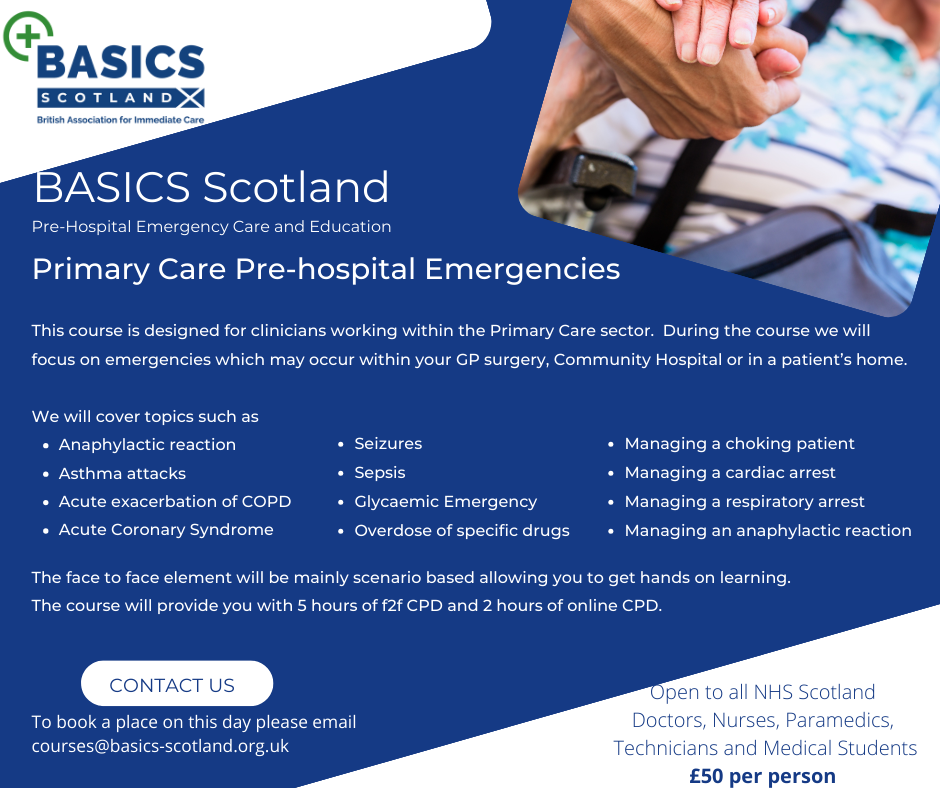
This is a one-day hands-on course which focuses on the knowledge and skills required deal with emergencies which may occur within your GP surgery, Community Hospital or in a patient’s home.

We will support you by providing access to our Primary Care learning modules in advance of your face to face teaching session to provide you with all the knowledge you need to attend.

Timetable:

This is a 1-day course, starting at 08.30 with registration and refreshments and ends at 16.00.

Refreshments are provided by BASICS Scotland, however lunch should be brought by candidates.

Core Skills – Multi-Agency Response

This is a one-day hands-on course which focuses on the knowledge and skills required to assess and treat pre-hospital emergency patients as part of a multi-agency response.

We will support you by providing access to pre-course reading materials in advance of your face to face teaching session to provide you with all the knowledge you need to attend.

The learning objectives for the day are:

  • Define Their own role, as well as that of other responders across the agencies in a prehospital setting
  • Identify The skills, equipment and roles that can be deployed in a prehospital event when working towards the best treatment and management of the patient
  • Discuss The skills, roles and responsibilities of the different agencies and the individuals within
  • Demonstrate Team working, interagency understanding, communication and cooperation
  • Outline How interagency working, when used to best effect, for the best management of the patient

How the day will run:

A one-day skills based experiential learning module with the aim of focusing on the knowledge and skills required to assess and treat a patient involved in a multi-agency pre-hospital medical event. This course focuses on the different agencies working together while using the skills and equipment that they would normally carry, to manage their combined resources for the best outcome for the patient.

The Session begins with a facilitated discussion around the learning needs of the group and any challenges they have faced in practice, the sessions then move to skill stations to learn and practice essential skills, this is then reinforced in scenarios enabling a chance to practice the assessment and treatment strategies from throughout the day.

The remainder of the learning focuses on the structured debrief of the scenarios and lessons learned from these sessions

Timetable:

This is a 1-day course, starting at 08.30 with registration and refreshments and ends at 16.30.

Refreshments are provided by BASICS Scotland, however lunch should be brought by candidates.

Cost:

£50 per person per day (this includes access to relevant e-learning modules)

How to book:

Please email courses@basics-scotland.org.uk in the first instance

Number of attendees:

Minimum 3, Maximum by arrangement

Eligibility:

Health Care Professionals responding to or working towards responding in the pre-hospital environment.

What do I need to bring?

Appropriate outdoor clothing and footwear for all weathers.

Hosting a core skills day:

If you wish us to come to your location and deliver to your staff please email courses@basics-scotland.org.uk

Wider context:

All our educational courses are available to health care professionals across Scotland who have an interest in or are working in the pre-hospital care field. The scope of educational materials ranges from on-line e-learning, podcasts, resource hub, tele-education (adult and paediatric). Core skills face to face teaching, virtual skills training (PODs), our Pre-hospital Emergency Care Course (PHECC) and our Pre-hospital paediatric life support course (PHPLS).
Core Skills – Maternity and Neonates

This is a one-day hands-on course which focuses on the knowledge and skills required to assess and treat pre-hospital obstetric and neo-natal resuscitation emergencies.

We will support you by providing access to pre-course reading materials in advance of your face to face teaching session to provide you with all the knowledge you need to attend.

The learning objectives for the day are:

  • Define their role in the assessment and treatment of patients experiencing prehospital obstetric and/or neo-natal resuscitation emergencies
  • Identify obstetric and neo-natal emergencies in the prehospital setting
  • Discuss the assessment and treatment options available in the pre-hospital environment
  • Demonstrate the assessments and possible treatments options for obstetric and/or neonatal resuscitation emergencies events in the prehospital environment
  • Outline the gold standard for treatment of the obstetric or neonatal resuscitation emergencies in the pre-hospital environment

What the day looks like:

A one-day skills-based experiential learning module with the aim of focusing on the knowledge and skills required to assess and treat a patient involved in an obstetric and/or neo-natal resuscitation emergency in the pre-hospital environment.

The Session begins with a facilitated discussion around the learning needs of the group and any challenges they have faced in practice, the sessions then move to skill stations to watch a demonstration of the skills after which they will practice the skills to enhance their competence. This learning is then reinforced in simulations which enables the learners to practice the patient assessment and decide upon and carry out the appropriate treatment strategies.

The remainder of the learning focuses on the structured debrief of the simulations and lessons learned from these sessions.

Timetable:

This is a 1-day course, starting at 08.30 with registration and refreshments and ends at 16.30.

Refreshments are provided by BASICS Scotland, however lunch should be brought by candidates.

Cost:

£50 per person per day (this includes access to relevant e-learning modules)

How to book:

Please email courses@basics-scotland.org.uk in the first instance

Number of attendees:

Minimum 3, Maximum 6

Eligibility:

Health Care Professionals responding to or working towards responding in the pre-hospital environment.

What do I need to bring?

Appropriate outdoor clothing and footwear for all weathers.

Hosting a core skills day:

if you wish us to come to your location and deliver to your staff please email courses@basics-scotland.org.uk

Wider context:

All our educational courses are available to health care professionals across Scotland who have an interest in or are working in the pre-hospital care field. The scope of educational materials ranges from on-line e-learning, podcasts, resource hub, tele-education (adult and paediatric). Core skills face to face teaching, virtual skills training (PODs), our Pre-hospital Emergency Care Course (PHECC) and our Pre-hospital paediatric life support course (PHPLS).
Core Skills – Paediatric

This is a one-day hands-on course which focuses on the knowledge and skills required to assess and treat common emergencies in the paediatric patient in the pre-hospital environment.

We will support you by providing access to our paediatric and patient assessment e-learning modules in advance of your face to face teaching session to provide you with all the knowledge you need to attend.

The learning objectives for the day are:

  • To demonstrate safe and effective airway maneuvers including the management of the choking child.
  • To demonstrate a structured approach to the respiratory and circulatory assessments of a child.
  • To practice management of acute asthma, initiate nebuliser treatment and know when to get further help.
  • To recognise cardiac arrest and demonstrate the paediatric Basic Life Support (BLS) and Advanced Life Support (ALS) algorithms including safe defibrillation.
  • To discuss traumatic injury in children and practice assessment and management of the paediatric patient including the appropriate use of splinting, pelvic binders and analgesia.
  • To recognise and initiate treatment for the septic child.

What the day looks like:

The session begins with a facilitated discussion during which we will get to know you, the work you do and your experience of managing and treating a paediatric emergencies to help us support you through the day.

After a short revision of pre-course learning, we start with the basics. You will be given the opportunity to practice the management of the paediatric airway including how to manage choking in the skills station. We will then help you to carry out a structured approach to the assessment of breathing and guide you through the process of setting up a nebuliser, supporting you to practise and then consolidate your learning by working as a team through 2 simulated scenarios.

Returning to the skills stations, we take you through circulation assessment before moving to practice CPR and defibrillation using the paediatric BLS and ALS algorithms. After lunch, we move again into simulated scenarios focused on medical and cardiac emergencies followed by our final skills stations which bring trauma skills into the day. We review the recognition and management of major haemorrhage including the splinting of limbs, application of pelvic binder and pain management. The final scenarios of the day allow you to integrate these skills into simulated trauma scenarios.

Feedback and debrief is central to all aspects of our day with you and our aim is to leave you more confident and competent in managing the care of the critically ill cardiac patient.

Timetable:

This is a 1-day course, starting at 08.30 with registration and refreshments and ends at 16.30.

Refreshments are provided by BASICS Scotland, however lunch should be brought by candidates.

Cost:

£50 per person per day (this includes access to relevant e-learning modules)

How to book:

Please email courses@basics-scotland.org.uk in the first instance

Number of attendees:

Minimum 3, Maximum 6

Eligibility:

Health Care Professionals responding to or working towards responding in the pre-hospital environment.

What do do I need to bring?

Appropriate outdoor clothing and footwear for all weathers.

Hosting a core skills day:

if you wish us to come to your location and deliver to your staff please email courses@basics-scotland.org.uk

Wider context

All our educational courses are available to health care professionals across Scotland who have an interest in or are working in the pre-hospital care field. The scope of educational materials ranges from on-line e-learning, podcasts, resource hub, tele-education (adult and paediatric). Core skills face to face teaching, virtual skills training (PODs), our Pre-hospital Emergency Care Course (PHECC) and our Pre-hospital paediatric life support course (PHPLS).

Core Skills – Trauma

This is a one-day hands-on course which focuses on the knowledge and skills required to assess and treat a patient suffering trauma in a pre-hospital environment.

We will support you by providing access to our trauma and patient assessment e-learning modules in advance of your face to face teaching session to provide you with all the knowledge you need to attend.

The learning objectives for the day are:

  • To demonstrate a structured approach to the Primary survey including identification of relevant life-threatening injuries.
  • To identify, treat and manage the patient with a suspected C-spine injury, who is wearing a helmet.
  • To practice identification, treatment and management of chest injuries and demonstrate effective needle decompression, considering its benefits and limitations.
  • To demonstrate an incremental approach to catastrophic haemorrhage control.
  • To demonstrate diagnosis and treatment of pelvic and femoral fractures where the splinting of injuries is indicated.
  • To describe the Traumatic Cardiac Arrest (TCA) algorithm and demonstrate clear management of a traumatic cardiac arrest with the HOT protocol.
  • To demonstrate appropriate packaging for the patient including use of pelvic binder, scoop, vac mat, collars and insulation for onward transport.

Outline of the day:

The session begins with a facilitated discussion during which we will get to know you, the work you do and your experience of managing and treating a patient who has suffered a traumatic injury, to help us support you through the day.

After a short presentation we start with the basics. You will be given the opportunity to learn to identify external catastrophic haemorrhage and practice management skills in the skills station. We will then help you to assess for a c-spine injury and guide you through the process of Manual In Line Stabilisation (MILS) and helmet removal, supporting you to practise and then consolidate your learning by working as a team through 2 simulated scenarios.

Keeping the skills stations going we take you through chest injury identification and management, before moving to discuss the role of splinting and letting you practice with our pelvic binders and traction splints. Our final skills station introduces the integral role of patient packaging and allow you time to handle and practice packaging equipment.
After lunch we spend the afternoon working through simulated scenarios as a team, pulling your knowledge and skills together. We will work through the care and treatment of the patient suffering trauma from chest injury to traumatic cardiac arrest increasing the complexity of the patient presentations as we progress.

Feedback and debrief is central to all aspects of our day with you and our aim is to leave you more confident and competent in managing the care of the critically ill cardiac patient.

Timetable:

This is a 1-day course, starting at 08.30 with registration and refreshments and ends at 16.30.

Refreshments are provided by BASICS Scotland, however lunch should be brought by candidates.

Cost:

£50 per person per day (this includes access to relevant e-learning modules)

How to book:

Please email courses@basics-scotland.org.uk in the first instance

Number of attendees:

Minimum 3, Maximum 6

Eligibility:

Health Care Professionals responding to or working towards responding in the pre-hospital environment.

What do I need to bring?

Appropriate outdoor clothing and footwear for all weathers.

Hosting a core skills day

If you wish us to come to your location and deliver to your staff please email courses@basics-scotland.org.uk

Wider context

All our educational courses are available to health care professionals across Scotland who have an interest in or are working in the pre-hospital care field. The scope of educational materials ranges from on-line e-learning, podcasts, resource hub, tele-education (adult and paediatric). Core skills face to face teaching, virtual skills training (PODs), our Pre-hospital Emergency Care Course (PHECC) and our Pre-hospital paediatric life support course (PHPLS).

Core Skills – Cardiac Arrest Management

This is a one-day hands-on course which focuses on the knowledge and skills required to assess and treat a patient who has suffered a cardiac arrest in the pre-hospital environment.

We will support you by providing access to our cardiac and patient assessment e-learning modules in advance of your face to face teaching session to provide you with all the knowledge you need to attend.

The learning objectives for the day are:

  • To practice identification, treatment and management of a patient’s airway, including supraglottic airways (SGAs).
  • Familiarisation with capnography and its place in cardiac arrest management.
  • To discuss use of and demonstrate safe insertion of intraosseous (IO) needle.
  • To practice identification, treatment and management of cardiac arrest and demonstrate safe and effective basic life support (BLS) advanced life support (ALS) and use of the Automated External Defibrillator (AED).
  • To discuss both the shockable and the non-shockable rhythm sides of the ALS algorithm and demonstrate effective care for the patient using both sides.

Outline of the day:

  • The session begins with a facilitated discussion during which we will get to know you, the work you do and your experience of managing a patient suffering a pre-hospital cardiac arrest.
  • Starting with the basics, you will be given the opportunity to practice airway management, basic life support and defibrillator skills in our skills stations and then consolidate learning by working as a team through 2 scenarios.
  • We then introduce you to IO needle insertion and allow you time to practice and receive feedback in our skills station. This is followed by a short tutorial on capnography to familiarise you with its use in cardiac arrest management.
  • After lunch we spend the afternoon working through scenarios as a team, pulling your knowledge and skills together. We will work through the care and treatment of the patient in shockable and non-shockable rhythms, increasing the complexity of the patient presentations as we progress.
  • Feedback and debrief is central to all aspects of our day with you and our aim is to leave you more confident and competent in managing the care of the critically ill cardiac patient.

Timetable:

This is a 1-day course, starting at 08.30 with registration and refreshments and ends at 16.30.

Refreshments are provided by BASICS Scotland, however lunch should be brought by candidates.

Community hospitals:

The day is a pre-hospital care course. We can however, tailor the same learning outcomes to provide for delegates who work in community hospitals. Please get in touch to discuss your requirements if this is of interest.

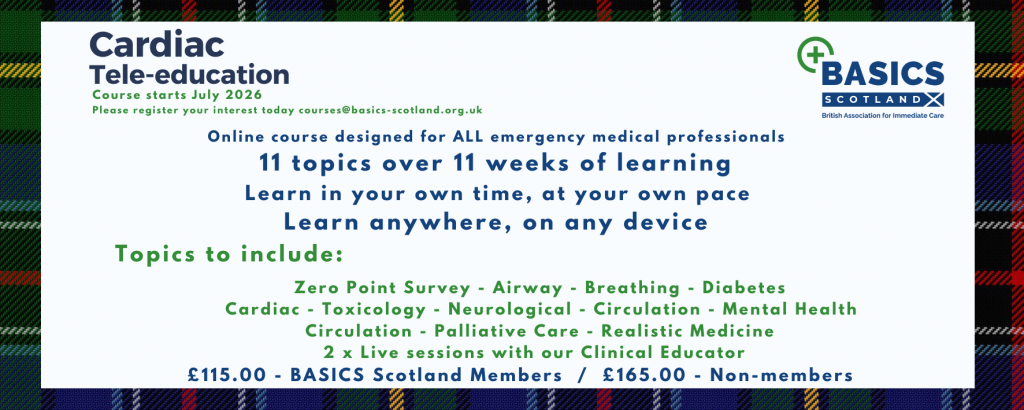
Adult Medical Emergencies Tele-education

Starts 21st July 2026

Begin your learning journey this July with an interactive, flexible and comprehensive online course in pre-hospital care, designed specifically for all pre-hospital medical professionals! With 11 essential topics over 11 weeks, you will gain valuable insights and practical knowledge to apply in the field, all at your own pace, wherever you are and on any device.

Course Highlights

Learn at Your Own Pace

This course is designed for busy professionals. Fit learning around your schedule with easy, self-paced modules.

11 Core Topics

Covering the essentials you need in pre-hospital care, including:

  • Zero Point Survey
  • Airway
  • Breathing
  • Diabetes
  • Cardiac
  • Toxicology
  • Neurological
  • Circulation
  • Mental Health
  • Palliative Care
  • Realistic Medicine

Live Sessions with Our Clinical Educator

Two interactive live sessions allow for Q&A, case discussions and additional learning with our experienced Clinical Educator.

Subsidised by NHS Education Scotland

This invaluable training is offered at a reduced cost of just £165 per person, providing affordable, high-quality education.

📅 Course Begins: July 2025
💻 Cost: £165 per person for 11 weeks

Elevate your pre-hospital expertise, improve patient outcomes and join a community of dedicated pre-hospital professionals in this accessible, expertly crafted course.

Don’t miss out — secure your spot today!

Course Begins: July 2026

Core Skills Days

We believe that all people who support pre-hospital care in remote and rural Scotland should have access to training, no matter where they live – welcome to the BASICS Scotland suite of core skills days.

Our ethos is bringing our clinical education team and instructors to your local area to facilitate experiential learning in small groups. Training can be provided in local centres or on the Mobile Skills Unit provided by NES.

Modules can be selected and attended as stand-alone sessions or as a learning set. They can be accessed by all who are involved with prehospital care and complement our other face to face and online courses.

This ‘pick and mix’ approach enables you to tailor your learning to your needs. These modules are not assessed and certification of attendance is provided.

Current core skills days available are:

We would look to hold 3-4 days of education whilst in your local area, please contact our Course Co-Ordinator at courses@basics-scotland.org.uk for more information on how to book our core skills days.

Paediatric Pre-Hospital Emergency Care Course

Course Background

The Paediatric PHEC course has been developed by BASICS Scotland, drawing on extensive experience from two well-established programmes:

  • Our long-running Pre-Hospital Emergency Care (PHEC) course
  • Our years of delivering ALSG’s Pre-Hospital Paediatric Life Support (PHPLS) course

This combined expertise has shaped a course that meets the unique challenges of paediatric emergencies in the pre-hospital setting — providing practical, evidence-based training tailored to the needs of healthcare professionals working in this demanding environment.

Course Programme

Sample Course Programme

Who is it designed for?

Our Paediatric PHEC course is designed for healthcare professionals who are involved in or have a keen interest in pre-hospital paediatric emergency care. Open to doctors, nurses and paramedics, this course offers a practical and immersive learning experience tailored to paediatric emergencies in the out-of-hospital setting.

Assessment Approach

We use a formative, continuous assessment model, meaning there is no final exam. This assessment method has been validated by the University of Dundee and has been successfully implemented since 2016. Each candidate receives personalised BIGCAT assessments with detailed feedback on their knowledge, skills and performance throughout the course.

Course Format

  • Duration: 2 days of face-to-face training
  • Location: Delivered in a mix of indoor and outdoor settings
  • Focus: Hands-on practice with realistic scenarios specific to paediatric care

Teaching Hours

  • Face-to-face teaching: 16 hours
  • Pre-course e-learning: 6hrs online learning provided by BASICS Scotland

Who Can Apply

This course is open to:

  • Registered healthcare professionals (doctors, nurses, paramedics)
  • Those with experience or interest in paediatric pre-hospital care

Pre-Requisites

Before attending, candidates are expected to have:

  • Current professional registration (Dr, Nurse, Paramedic)
  • Basic Life Support skills, including CPR and AED use
  • Completed manual handling training

Course Fees

  • NHS Scotland staff: £350 (subsidised rate)
  • Non-NHS Scotland clinicians: £1,300

Recertification

Certificates are valid for 3 years. To recertify, participants must attend a full Paediatric PHEC course.